/ Copywriting
TL;DR
If you run an e-commerce brand, the most crucial part of your business is marketing, and the number one skill you need to scale it is copywriting. Here are the rules of copy and the strategies that get you to $100k a month.
If you run an e-commerce brand, the most crucial part of your business is marketing.
And if the most crucial part of your business is marketing, then you need to get good at it.
To be good at marketing, you need to be good at writing words that convince people to buy your stuff.
And to be good at writing words that convince people to buy your stuff, you need to understand who those people are.
And once you understand who they are
You need to learn how to communicate that understanding to them.
“The Power of Your Copy Is In Direct Proportion To The Depth of Your Research” - Eugene Schwartz
How you communicate your understanding to them is…
Copywriting
So, for you to actually scale your eCom brand, the #1 skill that you will need is copywriting.
Easy right?
Well, the problem is that most people, especially nowadays with AI, are mediocre at copywriting.
And people prefer to press buttons in Meta to try to hack the system
Instead of learning a LEGIT skillset of copywriting.
And the truth is, being a good copywriter is hard.
Getting good at copywriting is like learning a new language.
And for most of you who aren’t people who grew up speaking 2 languages
Learning a language is damn hard.
So the truth is
If I were to just give you guys a template and a prompt, which I will, and tell you that that is all you need to create winning ads…
I would be doing you all a disservice.
The problem is, I’ve been copywriting for the last five years in e-commerce. So a lot of this stuff just comes “Natural to me” because I’ve done more reps.
But you already have the skillset of being able to find the information that will equip you with the knowledge of your specific customers.
However, the only thing that will hold you back from actually getting to the next level is your ability to execute it.
AKA your copywriting
And then after your copywriting, unfortunately, there is another caveat which is your ability to visually communicate it…
Although I will have a solution for you very shortly
My point is this: Copywriting is not a “nice-to-have” skill. It’s a MUST-HAVE SKILL.
It’s not really an option unless you can pay someone actually good
And even if you can pay, a lot of you don’t know how to attract them.
So…
What we’re about to cover is just a spec of what comes into copywriting.
But I need you to understand that, as I mentioned in the first line, learning copywriting is like learning a new language.
At first, it will be really rough.
You’re going to have to try to remember to do specific things.
You’re going to make mistakes
You’re going to sound like a baby speaking its first few words.
But after enough practice, it will just start to flow naturally.
And at the end of the day,
If there’s one skill that will keep food on your table for the rest of your life, even outside of eCom
It’s copywriting.
So lean in to this.
And be excited to develop and learn the skill.
Let’s dive in.
The Rules Of Copy
#1 - Nobody Cares About You, Your Company, or Your Product
The Beginner Mistake: Talking about how great your product is, how long you’ve been in business, your awards, and your mission.
The Truth: People are interested in themselves. Period. Frame everything through THEIR lens - their problems, their desires, their outcomes.
The Shift:
✕ “We’ve been in business for 20 years”
✓ “For 20 years, we’ve helped people like you solve [problem]”
#2 - Results Are All That Matter. Remove Your Emotion.
The Beginner Mistake: “I think this headline is better” or “This sounds good to me”
The Truth: The market decides what is good and what is not. Your job is to test, measure, and let data tell you what converts. And most importantly, USE THE DATA to complete feedback loops.
The Discipline: Never argue about copy. Test it. If it doesn’t convert, it’s wrong - no matter how much you like it.
#3 - Write How People Talk, Not How They Read
The Beginner Mistake: Writing in “proper” formal English like you learned in school.
The Truth: Copy should sound like a conversation. Use contractions. Short sentences. Start sentences with “And” or “But.” Write like you’re talking to a friend.
The Test: Read your copy out loud. If it sounds weird or stiff, rewrite it.
Pro tip: Use the https://hemingwayapp.com/ to confirm your writing is at a 6th grade level or below (can ask Claude to rewrite it if needed).
Examples:
✕ “This supplement facilitates enhanced metabolic function”
✓ “This tells your body to burn fat instead of storing it”
#4 - Copy is never too long… Only too boring.
The Beginner Mistake: “People won’t read long copy” - so they write short, incomplete copy.
The Truth: People who are interested in what you’re selling will read EVERYTHING, as long as it’s engaging.
#5 - Every Sentence Should Create a “Slippery Slide”
The Beginner Mistake: Writing sentences that let the reader stop and think.
The Truth: Your sentences should be a slippery slide. Once they start reading, they can’t stop until the end.
How to Do It:
End sentences with intrigue
Use open loops
Create curiosity gaps
Make each sentence lead naturally to the next
Never give them a natural place to stop until the CTA
Example:
✕ “Our product has three ingredients. They work together to help you.”
✓ “Our product has three ingredients. The first one does something no other supplement can do…”
#6 - Research is 80% of the Work
The Beginner Mistake: Just sitting down and writing with minimal research. Not stopping while writing to do more research if needed.
The Truth: Great copy comes from great research. The writing is just organizing what you learned.
What to Research:
✓ Customer reviews (their exact language)
✓ Competitor claims (what’s already been said)
✓ Amazon Q&A sections (their questions = your objections)
✓ Reddit/Facebook groups (raw, unfiltered pain points)
✓ Product mechanism (understand it deeply)
The Rule: Spend 2-3 hours researching for every 1 hour writing.
#7 - The Daily Practice (Kyle Milligan x Joe Schriefer)
If you do this for 90 days and you’ll be better than 90% of copywriters.
Read a piece of copy (active reading - analyze the subtext - what is being communicated?)
Write a page of copy (doesn’t have to be for an ad, can be for a landing page, a tweet, anything.)
Come up with an idea (keep asking “what if…”)
“What if I approached this project from a completely different angle?”
“Why did this ad stop me? What’s the hook pattern?”
“How would I improve this ad if it was mine?”
“Why did I just buy this? What was the trigger?”
“What would make me buy this faster?”
“I just got frustrated by X - that’s a pain point someone could sell into”
“Everyone in this niche says X - what if we said Y instead?”
“Nobody’s addressing Z objection - what if we led with that?”
Pro Tip: Keep a notes app on your laptop/phone (Apple Notes, Google Keep, Notion). Create a “Copy Ideas” section, hooks that stopped my scroll, etc.
Copywriting Strategies To Hit $100k/Mo+
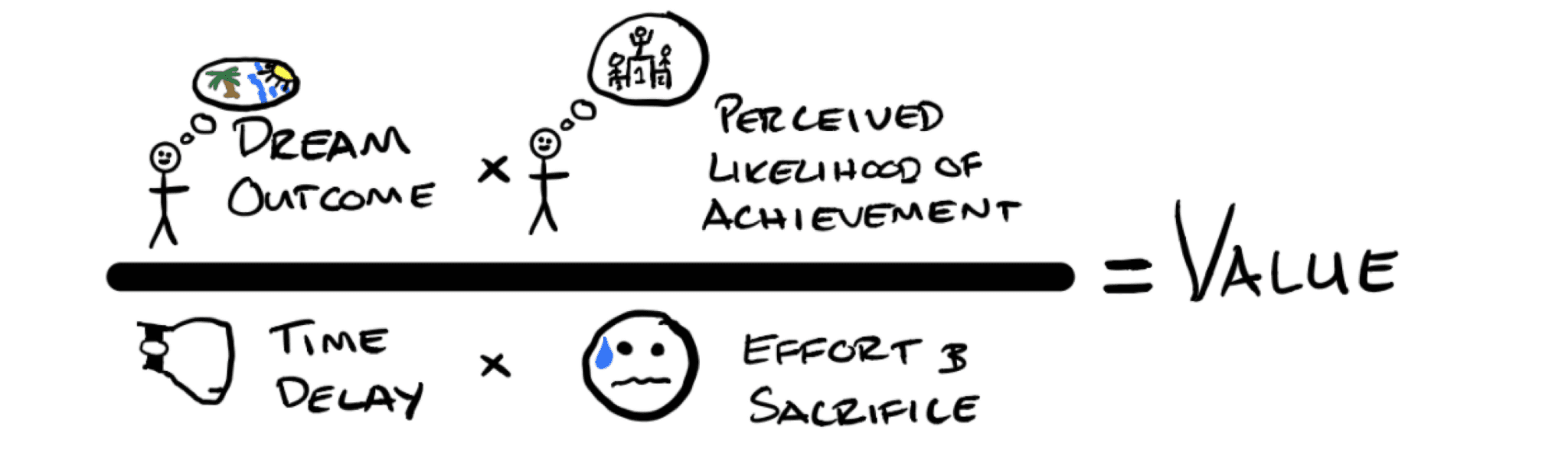
#1 - Understand what humans value
What is their dream outcome?
How likely are they to get it?
How long does it take them to get it?
How much effort does it take them?
And how much sacrifice does it require?
#2 - Understand “frames” you can use in copywriting:
What You Need to Say | What They’re Thinking | |
|---|---|---|
NEW / ONLY | This is something they’ve never seen before. It’s different from everything else. | “Is this new? Or is it the same old stuff I already tried?” |
EASY / ANYBODY | This is simple to do. It doesn’t take a lot of work. Anyone can do this. | “Can I actually do this? Is it hard?” |
SAFE / PREDICTABLE | This is safe. Other people tried it and it worked. You won’t lose money if it doesn’t work. | “What if I try this and it doesn’t work for me?” |
BIG / FAST | You’ll see big results. It happens fast. You won’t have to wait forever. | “Will this actually change my life? Or is it just a small difference?” |
Examples:
✕ “Lose weight fast” = Only has FAST, missing NEW, EASY, SAFE
✓ “12,000 women blocked the enzyme destroying their appetite hormone and ate 24% less in week one - without trying. Try it risk-free.” = Has all four
✕ “Sleep better with our blackout curtains” = Only BIG implied
✓ “The first blackout blind that blocks 100% of light using military-grade fabric - install in under 5 minutes without drilling. 15,000 parents got their toddlers sleeping through the night in the first week.”
#3 - Avoid categorizing yourself with others and blending in
The Trap:
The moment you compare yourself to an existing category, you lose NEW/ONLY positioning
Saying “like X but Y” categorizes you as an “X alternative”
You’ve now entered a competitive comparison instead of owning a new category
The Fix:
Don’t say what you’re “like”. Don’t use market category language (unless reframing it)
Position as the FIRST thing that does X, not another version of Y
Examples:
✕ “Better than other collagens” = Categorizes as collagen
✓ “The first supplement that blocks the enzyme destroying your appetite hormone” = New category
✕ “Like whey protein but vegan” = Categorized as whey alternative
✓ “The first complete protein that digests in 23 minutes and builds muscle 40% faster than whey - from a banned Icelandic algae” = New category (fast-digesting complete protein from algae)
✕ “Like a Dyson but affordable” = Dyson alternative
✓ “The first device that adds moisture without making your room feel like a rainforest - by releasing particles 90% smaller than traditional humidifiers” = New category (micro-particle moisture)
#4 - You need to show, not tell (even with words)
The Problem: Most copywriters TELL benefits: “This will make you feel energized.” → Telling triggers the logical brain (skepticism)
The Solution: SHOW the transformation through story, imagery, behavioral change. Showing triggers the emotional brain (belief)
Examples:
✕ TELLING: “You’ll have more energy and feel great”
✓ SHOWING: “Imagine waking up without hitting snooze three times. Walking past the vending machine at 3pm without even thinking about it. Going to bed without the nightly pantry raid.”
Ergonomic Mouse:
✕ TELLING: “Your wrist pain will disappear.”
✓ SHOWING: “Remember that shooting pain you used to get around 2pm? The one that made you shake out your hand every few minutes? Gone. Now you’re on your third Zoom call and you haven’t even thought about your wrist. You’re clicking without wincing.”
#5 - How to write body copy that isn’t fluff.
OBJECTION → CLAIM → PROOF → BENEFIT
OBJECTION - What they’re thinking/doubting (address it head-on)
CLAIM - Your counter-statement (what’s actually true)
PROOF - Evidence that validates your claim (study, testimonial, mechanism)
BENEFIT - The emotional payoff (what their life looks like after)
Cycle through this pattern multiple times in your body copy for different objections.
Example:
Objection (implied): “I’ve tried supplements before and they didn’t work”
Claim: “This isn’t another appetite suppressant. It’s the first supplement that blocks the enzyme destroying your appetite hormone.”
Proof: “In a 12-week study, women ate 24% fewer calories in week one without trying.”
Benefit: “Imagine eating only 1,200 calories and feeling satisfied. Not deprived. Just… done eating.”
#6 - The Roles of Market Awareness Levels
Market awareness is something you should already understand
But when it comes to writing, you must understand that when you write an ad, you have to go through each stage
Unaware → Problem Aware → Solution Aware → Product Aware → Most Aware
Problem Aware → Solution Aware → Product Aware → Most Aware
Solution Aware → Product Aware → Most Aware
Product Aware → Most Aware
The Role of Copy Length
Schwartz’s Awareness-Based Length Rules:
Awareness Level | Copy Length | Why |
|---|---|---|
Most Aware | Short | Just need the deal |
Product Aware | Medium | Need differentiation |
Solution Aware | Long | Need education on YOUR solution |
Problem Aware | Very Long | Need problem + solution education |
Unaware | Extremely Long | Need full journey from problem to solution |
The Principle: The less they know, the more you must teach. The more you must teach, the longer your copy.
Big Credits
$100M Offers - Alex Hormozi
This is a must-read for anybody in the online marketing space, if you ask me. Not only does this apply to copywriting, but it also applies to your actual offer on your landing page.
https://www.amazon.com/100M-Offers-People-Stupid-Saying-ebook/dp/B099QVG1H8/
Take Their Money - Kyle Milligan
This is a great copywriting book for those who are just getting into copywriting and need some kind of simplified, easy-to-follow guide.
A massive amount of this document is credited to him.
It has an aggressive name, but the principles this teaches are what I think anybody who wants to be successful in eCom has to know.
https://www.amazon.com/Take-Their-Money-Write-Really-ebook/dp/B0B94NRCVH
Eugene Schwartz - Breakthrough Advertising
This is the godfather of copywriting books.
https://breakthroughadvertisingbook.com/lp3-breakthrough-advertising/
Silvermoon is a private advisory practice for e-commerce founders. Tell us where the business is today and we’ll tell you honestly where we can help.
Apply now
BRANDS
A growth advisory for DTC brands.
Private. 1:1. By application.
CONTACT
© 2026 SILVERMOON BRANDS