/ Framework
TL;DR
Not all factors influence a customer’s purchasing decision equally. Here is how Silvermoon ranks them, from product to media buying, and why you should optimise in order of influence, not convenience.
Not all factors influence a customer’s purchasing decision equally. Some are fundamental to why people buy, while others determine how effectively that value is communicated and converted.
At Silvermoon, we view the hierarchy of influence as a framework for understanding where growth opportunities exist - and where optimisation efforts are most likely to have an impact.
The higher a factor sits on the pyramid, the greater its influence on the customer’s decision.
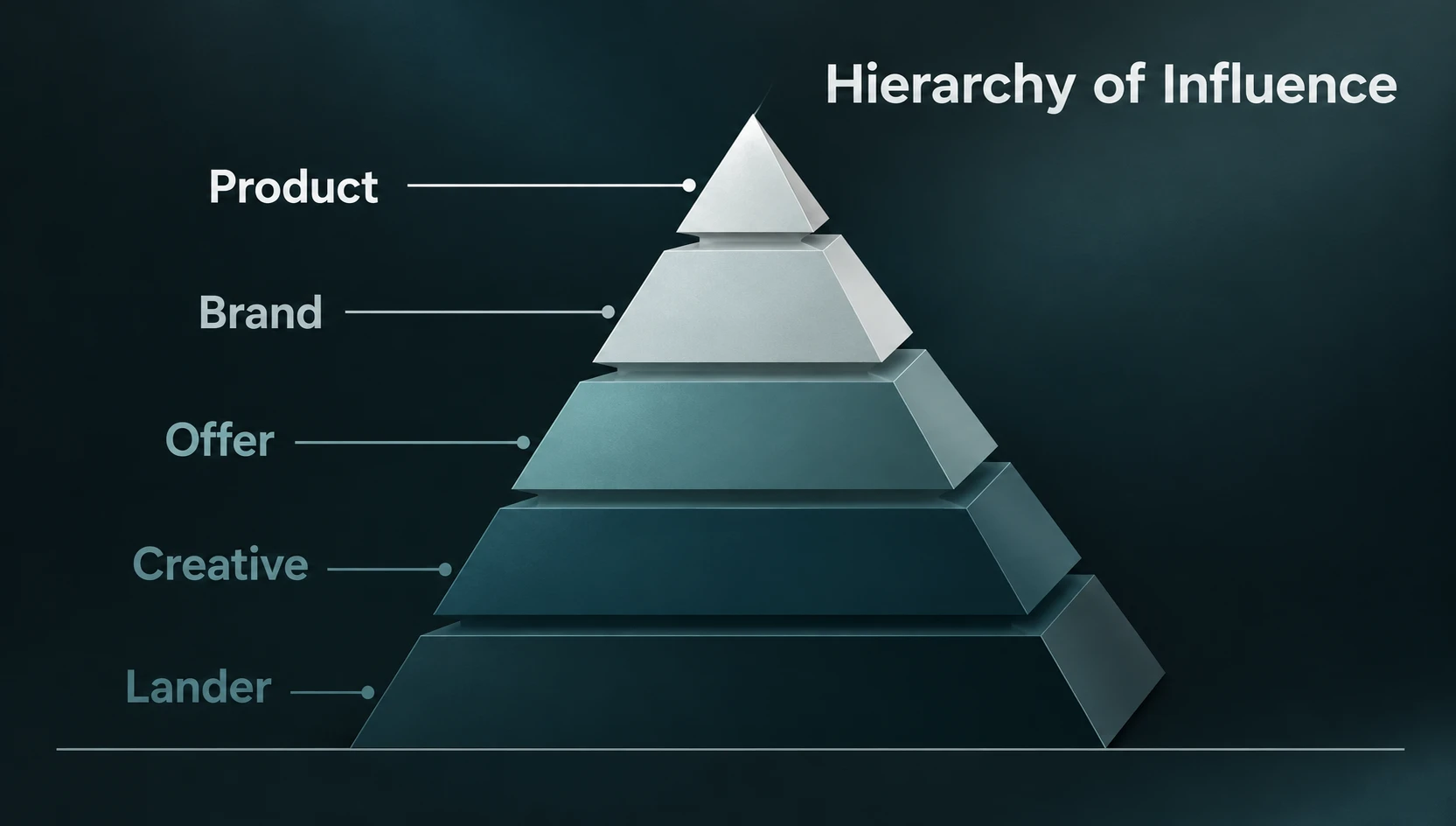
01. Product
The foundation of demand.
Customers buy products to solve problems, fulfil needs or achieve a desired outcome. Strong marketing can overcome product weaknesses, but the product itself ultimately shapes the value customers experience.
Everything begins with what you sell and why someone would want it.
02. Brand
The meaning behind the purchase.
Customers don’t just buy products. They buy into brands, identities and perceptions. A logo, a label or a reputation can influence which product someone chooses — even when alternatives offer similar functionality.
A strong brand builds recognition, trust and perceived value, giving customers reasons to choose you beyond the product itself.
03. Offer
The most flexible lever in the funnel.
Of the factors you can actively optimise, the offer is one of the most powerful. Pricing, bundles, bonuses, guarantees, payment options and perceived value all influence whether a customer decides to buy.
Changing a product or repositioning a brand can require significant time and resources. An offer, by contrast, can be tested and refined continuously.
When the product and brand are established, improving the offer can unlock substantial gains without changing what you sell.
04. Creative
How value captures attention.
Creative translates your product, brand and offer into a message that earns attention and creates desire.
Strong creative can make an effective offer compelling, communicate value quickly and give customers a reason to take action. It can also help an average landing page convert — whereas an excellent landing page cannot fully compensate for creative that fails to generate interest.
05. Landing Page
Where interest becomes action.
The landing page turns the promise made in your advertising into a purchasing decision.
Messaging, structure, product presentation, social proof, trust signals and user experience all play a role. Even strong advertising can underperform when the landing page introduces friction or fails to reinforce the offer.
Its job is to carry the momentum created by the preceding stages through to conversion.
06. Media Buying
The distribution layer.
Media buying determines how effectively your message reaches the right audience, at the right cost and at the right scale.
Campaign structure, audience strategy, budget allocation and optimisation remain important. However, media buying operates downstream of the factors above it.
Better distribution can amplify a strong proposition, but it cannot reliably fix a weak product, an uncompetitive offer or creative that fails to resonate.
The strategic takeaway
Optimise in order of influence, not convenience.
When performance stalls, the instinct is often to restructure campaigns, adjust targeting or change budgets. Yet the constraint may sit much further upstream.
Before increasing spend, assess the product, brand, offer and creative. Then evaluate the landing page and media buying strategy.
The objective isn’t to optimise everything simultaneously. It’s to identify the factor currently limiting growth and address it first.
Silvermoon is a private advisory practice for e-commerce founders. Tell us where the business is today and we’ll tell you honestly where we can help.
Apply now
BRANDS
A growth advisory for DTC brands.
Private. 1:1. By application.
CONTACT
© 2026 SILVERMOON BRANDS