/ Product Research
TL;DR
How to identify promising products by understanding mass desire, customer awareness, and market sophistication, and why testing more products is not a substitute for understanding the customer.
What is a winning product?
The common e-commerce approach is to test a large number of products, identify one that generates a strong return in the first few days, increase the advertising budget, and continue testing for more winners. This process can produce revenue, but it does not necessarily teach you why a product sells or how to build a business that can keep growing.
When you copy a product that works for another brand, you are copying the result without necessarily understanding the reasons behind it. You may not know which desire it satisfies, why the product page works, why the offer is attractive, why the ads connect with customers, or how the product fits the market.
The aim is not just to find a product that sells. It is to understand why people want it, how to position it, and what makes it competitive.
This masterclass explains the core principles to consider before choosing a product and investing in marketing.
01. The problem with spam testing
Why testing more products is not enough
The product-testing model is easy to understand: test products until one produces a strong return, scale it, then keep testing to find the next winner. The weakness is that the process can turn into repetitive execution without building the knowledge needed to make better decisions.
There are three main problems with this approach.
1. You copy other people’s winners. When you copy a product that is already successful, you may not know why it works. You do not necessarily understand the desire behind it, what makes the offer appealing, why the product page converts, why the ads work, or how the brand has positioned the product for its audience.
2. You depend on luck. If thousands of other sellers are copying the same products, you are competing in a crowded field without a clear advantage. Your results may depend on timing, creative execution, and luck rather than a repeatable understanding of the market.
3. You keep testing without learning. Constantly launching new products can become a routine of setting up campaigns, testing, turning products off, and starting again. The activity may be demanding, but it does not automatically improve your ability to identify opportunities or build a differentiated offer.
What happens next? There are two possible outcomes.
You find a product that works. You make a profit and may find more products, but competition eventually increases. Without a clear reason customers should choose your brand, growth can become harder to sustain.
You fail to find a product that works. You spend your budget on repeated tests without developing the knowledge or economics needed to move forward.
Testing is useful when it validates a hypothesis. It is not a replacement for understanding the customer and the market.
02. Start with mass desire
What makes a product a winner?
A winning product satisfies a mass desire: an outcome that a large number of people want, either around the world or within a specific country or audience.
Examples of mass desires include:
I want to lose weight.
I want my hair back.
I want to walk without pain.
I want my dog to be healthy.
I want my children to do well in school.
I want to feel more confident in my social or romantic life.
I want my insurance to help cover my medical bills.
These desires are not products. They are the outcomes people are trying to achieve. The product is the means through which they hope to achieve that outcome.
A product opportunity becomes interesting when a meaningful desire is shared by many people and the product offers a credible way to satisfy it. The desire may be broad, or it may be concentrated in a particular market such as the United States.
Start by identifying what people want. Then look for products that can help them get it.
03. Magnitude of desire
How strongly does the customer want the outcome?
Finding a mass desire is not enough. Some desires are easier to sell against than others. The magnitude of desire describes how much a person is willing to do to satisfy a desire. A key factor is the impact of leaving the problem unresolved.
The impact can be physical or practical. People who are overweight may experience reduced mobility. Some health-related problems can increase the risk of serious conditions.
The impact can also be emotional. Low self-esteem. Shame, guilt, frustration, or reduced confidence.
The stronger the effect of an unmet desire on a person’s life, the more motivated they may be to seek a solution.
This does not mean every strong desire creates a viable business. The product still needs to address the problem credibly, and customers need a reason to believe it can help.
Look for a product that addresses a powerful desire, not merely a passing interest.
Research should uncover what customers want to change, how the problem affects them, what they have already tried, and why existing options may not have worked for them.
04. The five stages of awareness
What does the market already know?
The level of market awareness describes how much customers understand about their problem, the available solutions, and specific products. This affects how much work your marketing must do before a customer is ready to buy.
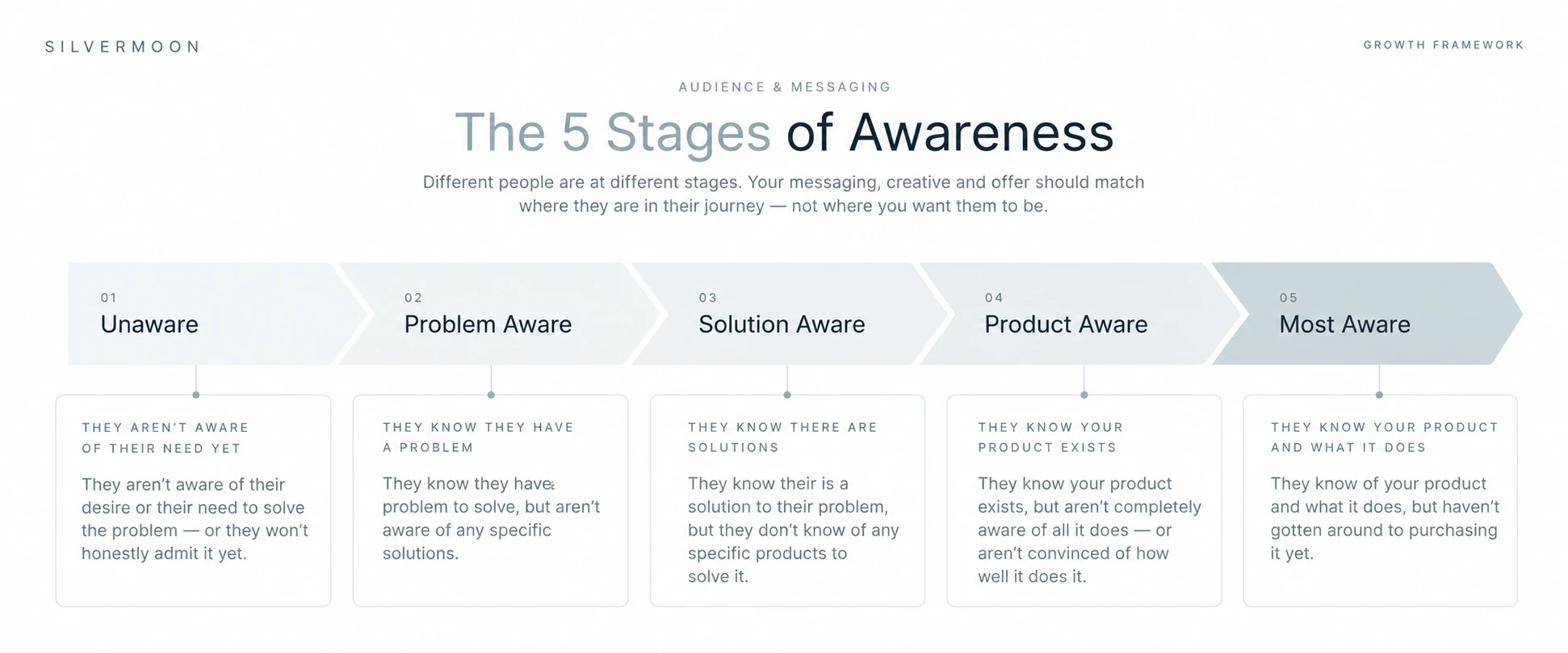
Selling to an unaware audience is difficult because those people do not yet recognise the problem. Your marketing has to make them understand why the issue matters before presenting a product as the answer.
Selling to people who are solution-aware or product-aware is generally easier. They already recognise the need and are looking for a way to satisfy it, or are evaluating specific products.
When starting out, consider products in markets where customers are already solution-aware or product-aware. They are actively looking for answers, so you may need less effort to explain the category itself.
05. Market sophistication
How crowded is the market?
Market sophistication describes how many competitors are trying to satisfy the same desire and how many claims customers have already heard. The more brands that compete for the same audience, the harder it becomes to stand out with a familiar promise.
If you enter a market with a product that satisfies a desire no one else has addressed, you may have an exceptional opportunity. But completely untapped markets are rare. Most brands do not need to invent a new desire or reinvent an entire category to build a successful business.
Davie Fogarty and The Oodie
Davie Fogarty, the creator of The Oodie, is an example of the advantage of entering a niche early. The brand entered its market at a time when the opportunity was relatively under-served and went on to grow to substantial scale. Early entry gave the brand room to establish its position before the market became more crowded. Its execution also mattered.
The lesson is to recognise under-served opportunities when you find them, while understanding that early entry is not a strategy you can reliably depend on.
You do not need to wait for the next untapped market. You need to understand how market sophistication affects the way you position and sell a product.
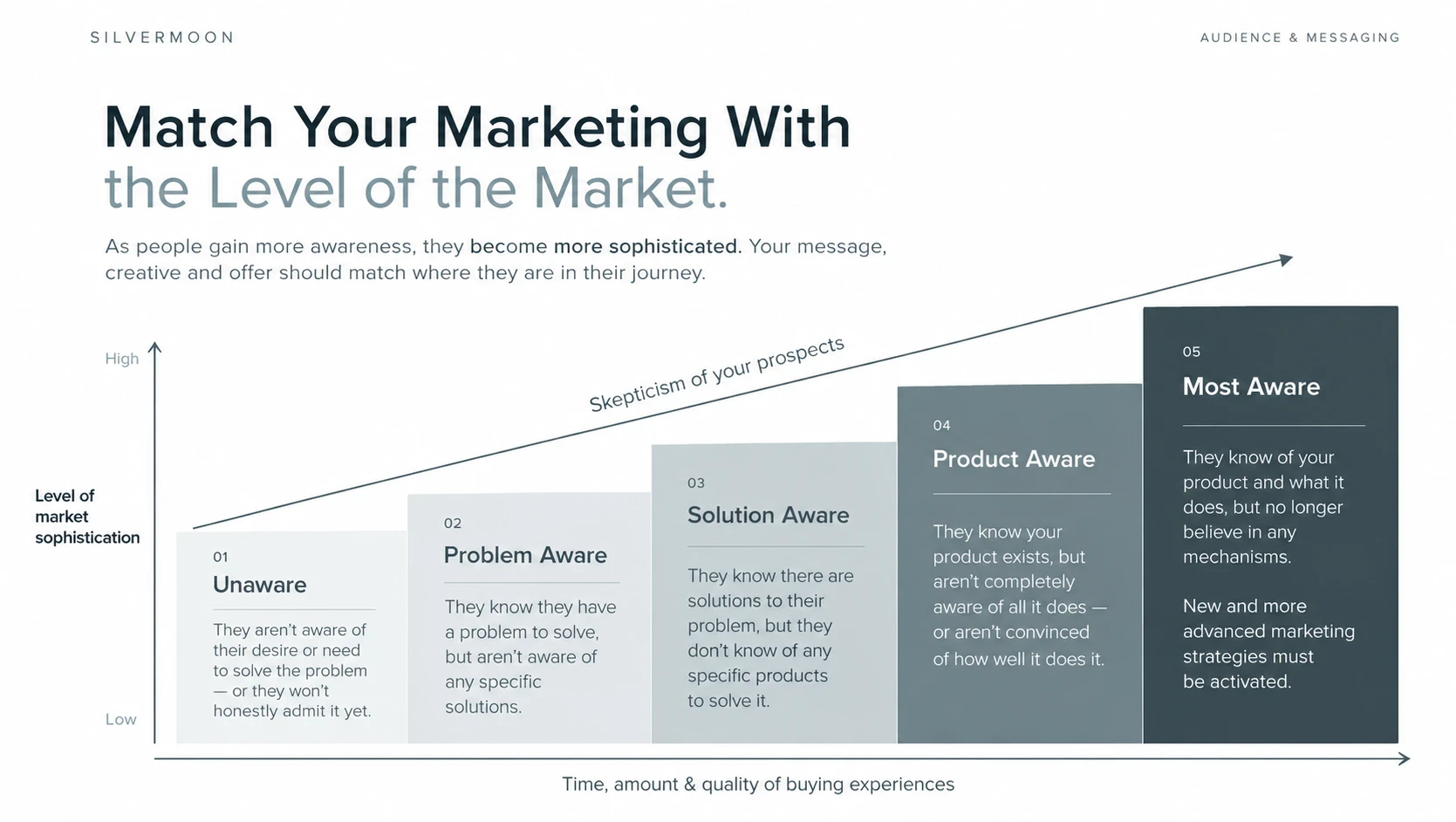
Five practical levels of market sophistication
Level 1, emerging market: Introduce the category and make a clear claim.
Level 2, developing market: Make your claim and value proposition more compelling than competitors’.
Level 3, competitive market: Explain the mechanism or reason your product can deliver the claim.
Level 4, mature market: Improve the mechanism or offer and demonstrate a meaningful difference.
Level 5, highly saturated market: Customers have heard many similar claims. More advanced positioning, proof, customer experience, and trust are needed.
06. Example: The weight-loss market
Why established markets require stronger positioning
Weight loss is an example of a highly sophisticated market. It has been saturated for years, and customers have seen countless products, diets, supplements, exercise plans, and bold promises. Many no longer believe in miracle solutions and are sceptical of claims that sound like the same promises they have heard before.
The desire to lose weight remains strong. The challenge is that customers have many options and may have tried several approaches already. In this environment, a broad claim is rarely enough. Marketing needs to build trust and show why the product is relevant and different.
One widely understood point is that exercise can support weight loss. A product entering this market must therefore offer a reason for customers to choose its particular approach over the alternatives.
In a saturated market, the task is not simply to make a bigger claim. It is to make the product’s value credible and distinct.
07. Case study: Infinity Hoop
How to compete when the market is saturated
Infinity Hoop is an example of a product competing in the crowded weight-loss market. The market already offered supplements, special diets, gym training, running, and many other ways to pursue the same outcome.
A major barrier for many people is not a lack of information about weight loss. It is the difficulty of sticking to an approach that requires consistent effort and discipline. The product therefore needs to address two central objections.
Objection 1: Will it help me get the result I want? Customers want to know whether the product can help them make progress. Marketing can use relevant customer experiences and social proof to demonstrate how people use the product and what results they have achieved. Claims must remain accurate and should not imply that everyone will get the same result.
Objection 2: Will it be easier to stick with? Customers may compare the product with going to the gym, running, or other activities they find difficult to maintain. The marketing can show the experience of using the product and make its appeal tangible.
How the marketing addresses these objections
Social proof: Show the customer’s journey and experience with the product, giving prospective buyers a relatable example.
Demonstration: Show people having fun while using the product, rather than relying only on a written promise.
The product has a feature that allows people to exercise while making the activity feel more enjoyable. That experience gives the brand a way to stand out in a market where customers have already seen many claims and alternatives.
A useful differentiator changes the customer’s experience in a way they care about. Make that difference visible, then address the objections that could stop them from buying.
08. Apply the framework
A practical product research process
Before committing significant budget to a product, work through the following questions.
Mass desire: What outcome does the customer want, and how many people share that desire?
Magnitude of desire: How important is the outcome, and what is the impact of leaving the problem unresolved?
Market awareness: Does the audience recognise the problem, know the solutions, or already know products like yours?
Market sophistication: How many competitors and similar claims has the customer already seen?
Positioning: What gives the product a credible reason to be chosen over the alternatives?
Objections: What might make a customer doubt the product or hesitate to buy?
Creative: How can the product’s benefit, experience, proof, or difference be shown clearly?
Use the answers to form a product and marketing hypothesis. Then test that hypothesis and learn from the results.
The purpose of research is not to guarantee that every product will succeed. It is to make the decisions behind each test more informed.
A strong product opportunity combines a meaningful desire, a market that can be reached, and a credible reason for customers to choose your offer.
Silvermoon is a private advisory practice for e-commerce founders. Tell us where the business is today and we’ll tell you honestly where we can help.
Apply now
BRANDS
A growth advisory for DTC brands.
Private. 1:1. By application.
CONTACT
© 2026 SILVERMOON BRANDS